

Thank you for Subscribing to Cannabis Business Insights Weekly Brief

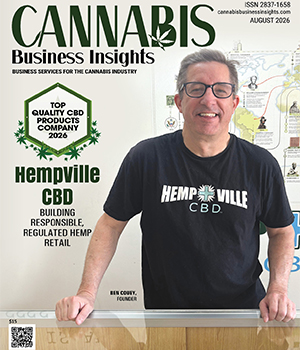
 Ben Couey, Owner
In 2018, when the Farm Bill legalized hemp and opened access to hemp cannabinoids, most people still did not understand CBD or hemp cannabinoids. Everywhere you turned, CBD was being sold and promoted, yet the stories were completely divided. Some people said hemp products changed their lives and helped with certain issues. Others said hemp did nothing and called it snake oil.
My wife and I had a combined 13 doctors, pharmacists and nurses in our families, so we started asking them about hemp cannabinoids. They all gave us the same answer: if done correctly, hemp cannabinoids can be very beneficial and could compete with many over-the-counter pain medications, but like anything else, they have to be done correctly.
Our research showed that many products being sold had inadequate labels, no ingredient list, no dosage information and no supplement facts. Customers often had no idea what they were buying. Some products were watered down, inconsistent or made by people without real scientific knowledge. You did not know whether the product came from an amateur who watched a few online videos or from a professional, such as a doctor or pharmacist, who understood the science.
As I read medical studies, I realized hemp cannabinoids could be “lightning in a bottle.” For certain common issues, they offered a natural option that could help people avoid immediately reaching for another pill. One doctor told me that when someone can handle an issue naturally through diet, exercise and natural medicine, they are often better off, because once one pill starts, several more may follow.
The bigger issue was customer confusion. People wanted correct information about what these products were and how they worked. I saw a major education gap. Many hemp store clerks knew just enough to sell products, but not enough to educate customers. Every customer is different. Hemp is not one-size-fits-all. Different products and applications serve different needs.
That is why our business plan focused on professional-grade products made by doctors and pharmacists, products that work, produce consistent effects, provide proper labeling and are safe for customers. Quality, consistency and professionalism are the only ways to build trust, close the education gap and stand apart in an industry where many still are not doing that. It also meant refusing to chase hype. We wanted customers to know what was in each product, why it was selected and how to use it responsibly.
Consumer Trust: Regulation Starts with Better Education
Every industry has people who cut corners and sell subpar products just to make money. In hemp, the challenges include incorrect labeling, underage usage, tainted or inconsistent products and unethical retailers. These problems exist largely because of the lack of government regulation around hemp. That lack of regulation is tied to an education gap between lawmakers and the industry, which I believe is the biggest challenge we face.
For the last three years, I have worked with lawmakers to fight hemp elimination bills in our state. Most lawmakers only hear the negative stories caused by unprofessional wholesalers and retailers. Through education, I have been able to show them that hemp cannabinoids, when made by professionals, can be beneficial to communities and offer people a safer way to manage certain issues. The lack of regulation has turned the industry into the Wild West. Education is the only way to achieve common-sense regulation that protects customers and allows responsible businesses to grow.
-
HempVilleCBD stands for HEMP = Help Educate More People, Ville = We should all look out for one another in the communities we live in.
Another challenge is competition from other industries. Hemp cannabinoids are strong products. Many customers have told us they lowered prescriptions, got off addictive opioid medications, stopped drinking alcohol or found hemp better for them than medical marijuana, especially when marijuana caused paranoia. In their experience, hemp produced less of that effect.
The bottom line is that hemp is taking market share from powerful industries, including big pharma, alcohol and medical marijuana. Those industries have well-funded lobbying groups and political connections. Each year, many fight to eliminate hemp cannabinoids from the marketplace while lobbying for exceptions that would allow only their products to use them.
Cannabinoid Formulation: Every Product Needs a Purpose
The hemp industry constantly evolves. Each year, new products enter the market with different formulations intended to improve results. At first, products were usually CBD or THC. Now many combine cannabinoids for targeted effects, such as CBD and CBG for pain, CBD and CBN for sleep, or THC and CBD to reduce the paranoia effect some people experience with THC.
When we review any new formulation, we ask the same questions. How will this benefit the consumer? What is the use case? Are there major side effects? Who formulated it? Was it made by a professional, such as a doctor or pharmacist? Customers want high-quality products that work, are professionally made, produce consistent effects and are safe. Those questions guide every product we bring into the store. If those answers are not clear, the product does not belong on our shelf, no matter how popular the category becomes.
Hemp Market Future: Organization Will Protect Opportunity
I believe the industry has no limit and can do a lot of good for society. I believe hemp cannabinoids can replace many over-the-counter products used for sleep, anxiety, pain and depression, and possibly some prescription medications. I also believe hemp could replace part of the alcohol market. Alcohol may make someone feel good, but it can damage the body and become addictive. Hemp cannabinoids such as THC or THCa can offer a similar euphoric feeling for some consumers without affecting them the same way alcohol does.
But that future will not happen without a fight. Big pharma, alcohol and medical marijuana are working hard to eliminate hemp, even though hemp is federally legal. Many states have little regulation or have banned hemp entirely. Often, those states already have a medical marijuana program or are trying to create one.
For hemp to survive and grow, the industry has to focus on education and organization. Lawmakers need better information, and retailers must support their state hemp coalitions. If a state does not have one, it needs to form one. Big pharma, alcohol and medical marijuana have had lobbying groups for decades. Hemp has only been federally legal since 2018 and is still building the structure needed to navigate political headwinds.
I tell retailers that if they wait for someone else to decide their future, that future will serve someone else’s interests, not theirs. We have an opportunity to help shape regulations that will define the industry. If retailers do not support local or national hemp coalitions, they are leaving hemp’s future in someone else’s hands.
Career Advice: Knowledge Builds Credibility
The best advice I can give emerging professionals is to be ready to learn and never stop learning. This industry grows, evolves and changes every year. With more research happening, that evolution will only accelerate.
Because hemp is still new, the average person does not know much about it, and neither do many lawmakers. That lack of knowledge creates room for fraud, inaccurate information and misconceptions. In this industry, knowledge really is power. Know your products, keep learning, stay honest and you can go far. That is the formula for success.
A Practical Standard for Trustworthy CBD Retail and Product Quality
Confidence in CBD products remains uneven across the cannabis business, shaped less by demand and more by inconsistency in product integrity, labeling clarity and consumer understanding. Buyers navigating this space are not challenged by availability but by credibility. Shelves are filled with options that vary widely in formulation standards, sourcing transparency and dosage reliability, leaving end users exposed to uncertain outcomes and, in some cases, avoidable risk.
The most reliable CBD providers distinguish themselves not through branding but through disciplined sourcing and verification practices. Products backed by professional formulation, often involving medical or pharmaceutical expertise, signal a level of accountability that extends beyond marketing claims. Independent testing documentation plays a critical role here, ensuring that what appears on the label reflects actual content. Absence of clear dosage information, ingredient transparency or origin traceability introduces uncertainty that undermines both user safety and long-term trust. Buyers who prioritize verifiable quality over price-driven procurement tend to achieve more consistent outcomes while reducing downstream liability.
“Products backed by professional formulation, often involving medical or pharmaceutical expertise, signal a level of accountability that extends beyond marketing claims.”
Clarity in labeling and consistency in product performance carry equal weight. Customers frequently encounter products that lack essential information, leaving them unable to determine potency or suitability. This gap creates a disconnect between expectation and experience, often leading to dissatisfaction or misuse. Reliable providers mitigate this by ensuring every product is accompanied by comprehensive labeling and validated testing, enabling informed decisions at the point of purchase. Consistency from batch to batch further reinforces confidence, turning one-time buyers into repeat customers and allowing retailers to build stable demand patterns.
Education remains a defining factor in this sector. The complexity of CBD interactions, especially when combined with other medications, requires a level of guidance that extends beyond transactional retail. Buyers increasingly value partners who can translate product science into practical understanding, helping end users navigate dosage, timing and potential interactions safely. Staff training becomes a differentiator, not just in product familiarity but in the ability to anticipate risks and address questions customers may not yet know to ask. Retail environments that prioritize engagement over speed create a feedback loop in which customer experience informs product selection, pricing alignment and overall service refinement.
Sustained success in CBD retail is grounded in trust, built through consistent product quality, transparent information and informed customer interaction. Pricing plays a role, but only when aligned with these fundamentals. Customers respond to honesty and clarity more than promotional appeal and their purchasing behavior offers the most accurate measure of product effectiveness over time. Businesses that listen closely to this feedback gain a clearer understanding of what performs, what fails and where adjustments are needed.
Hempville CBD exemplifies this disciplined approach by centering its business on education, verified quality and customer engagement. It curates products from established brands with professional formulation oversight, ensuring each item is supported by independent testing and clear labeling. Its emphasis on staff training enables informed guidance, particularly in identifying potential product interactions and appropriate usage. Rather than competing on price alone, it aligns fair pricing with consistent quality and transparent sourcing. This combination positions it as a dependable partner for buyers prioritizing safety, clarity and long-term customer trust in CBD retail.
...Read more
